Description
PrymaLab · Research Use Only
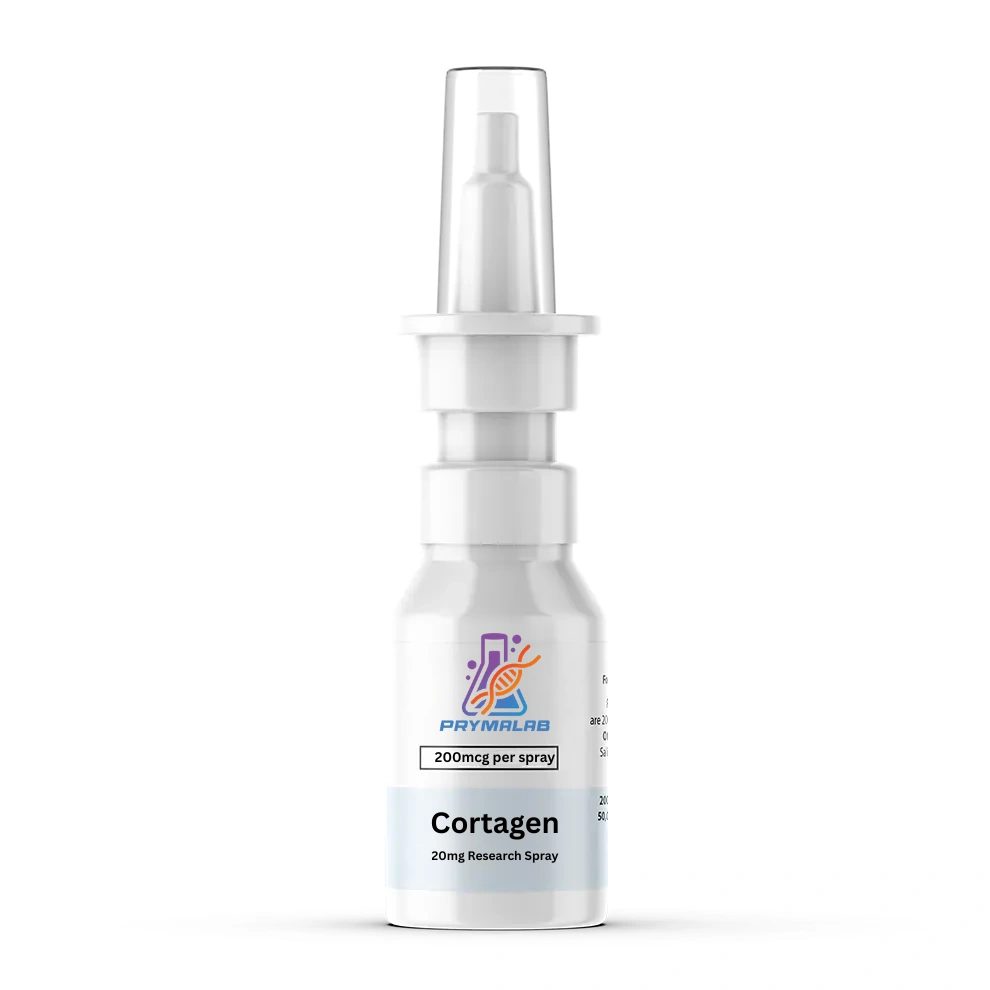
Cortagen Nasal Spray
Ala-Glu-Asp-Pro tetrapeptide · 430.4 Da · the second proline compound
Cortagen nasal spray supplies the tetrapeptide Ala-Glu-Asp-Pro in a metered aqueous solution at roughly 430.4 daltons. Two compounds in this family end in proline and this is one of them, which places it at the durable end of a range where most members degrade faster in water than out of it.
Specification Table
| Property | Value |
|---|---|
| Compound | Cortagen |
| Sequence designation | AEDP |
| Amino acid sequence | Alanine-Glutamate-Aspartate-Proline |
| Sequence provenance | Secondary sources, converging. Not traced to a single primary citation. Confirm against the lot certificate before relying on it for calculation |
| Residue count | 4 |
| Molecular formula, calculated | C17H26N4O9, derived from the stated sequence rather than from a registry entry |
| Molecular weight, calculated | Approximately 430.4 g/mol, computed from standard residue masses plus water |
| Also listed as | Cortagen spray, Cortagen peptide, Cortagen 20mg nasal spray, and the common misspelling Cortagene 20 mg |
| Terminal residue | Proline |
| Other proline-terminating compound here | Prostamax (Lys-Glu-Asp-Pro) at roughly 487.5 |
| Solution-state advantage | Asp-Pro resists the succinimide rearrangement that affects Asp-Gly sequences |
| Solution-state caution | The Asp-Pro bond is unusually acid-labile |
| Net charge at neutral pH | Negative. Two acidic residues, no basic residue |
| Chromophore | None. Concentration cannot be determined by 280 nm absorbance |
| Format | Metered nasal spray, solution state |
| Physical state | Aqueous solution, supplied ready to use |
| Purity | Per lot-specific certificate of analysis |
| Storage | 2-8°C, protected from light. Do not freeze |
| Regulatory status | No approved human or veterinary formulation in any jurisdiction |
Why Does the Proline Cut Both Ways in Cortagen Nasal Spray?
The terminal proline gives this compound one clear advantage and one specific vulnerability, and both are aqueous-phase properties rather than structural curiosities.
The advantage first. Aspartate followed by glycine rearranges readily through a succinimide intermediate, which is what troubles Chonluten, Epitalon and Testagen in solution.
Proline is among the poorest partners for that reaction. Its ring geometry obstructs the approach the aspartate side chain has to make onto the following backbone nitrogen.
So this compound resists the degradation route that silently affects several of its relatives, which is a real advantage for a product held in water for months.
The vulnerability is narrower and less well known. An aspartate-proline bond is unusually susceptible to acid-catalysed hydrolysis.
That bond cleaves under mildly acidic conditions at rates far above an ordinary peptide bond, which is why Asp-Pro is used deliberately as a chemical cleavage site in protein chemistry.
At neutral pH the reaction is slow enough to ignore. Below roughly pH 4 it is not. A formulation drifting acidic would degrade this compound at a specific and predictable point.
That gives an unusually precise pH instruction: keep the solution neutral, and regard acidification as the one condition to avoid rather than a generic caution.
It is worth being clear about how unusual the acid lability is, since the claim sounds stronger than a general caution about pH.
Ordinary peptide bonds hydrolyse slowly enough under mild acid that the reaction is irrelevant on any laboratory timescale.
The aspartyl-prolyl bond is the documented exception, cleaving orders of magnitude faster under the same conditions through a mechanism involving the aspartate side chain.
Protein chemists exploit that difference deliberately, using dilute acid to cut proteins at Asp-Pro sites where no enzyme is available.
What Should the pH Actually Be?
A specific vulnerability deserves a specific answer rather than a vague instruction to store correctly.
The working window is roughly neutral. The risk is entirely on the acidic side rather than symmetric.
Above neutral the Asp-Pro bond is stable, and the succinimide route that would normally threaten an aspartate is obstructed by the proline as described above.
Below roughly pH 4 the acid-catalysed cleavage becomes meaningful, and it produces two fragments rather than a rearranged intact molecule.
That difference matters analytically. Fragments have different masses, so this degradation is detectable where the isomerisation affecting other family members is not.
Cleavage at the Asp-Pro bond would leave Ala-Glu-Asp at roughly 333.3 and free proline. A species near 333 in the mass spectrum would indicate it.
A periodic pH check on an opened bottle is therefore worth running, and unlike most such advice it is checking for something with a known threshold and a known signature.
Where a formulation contains a buffer, knowing which buffer and at what pH is a reasonable question to put to a supplier for this compound specifically. Citrate and acetate buffers both sit in the acidic range, and either would be an odd choice here. A phosphate buffer near neutral would not.
How Does the Proline Pair Compare?
Two compounds in this family end in proline and setting them side by side shows what the shared terminus does and does not determine.
Prostamax is Lys-Glu-Asp-Pro at roughly 487.5, and this compound is Ala-Glu-Asp-Pro at roughly 430.4. They differ only at the first position.
Both carry the same acid-labile Asp-Pro bond, so the pH caution above applies equally to both and asking about it once covers the pair.
Both carry the same cis-trans isomerisation behaviour that broadens chromatographic peaks, so a purity figure for either needs a column temperature stated to be interpretable.
They differ in charge. The lysine in Prostamax cancels against the acidic residues to leave a near-neutral molecule, while the alanine here leaves this compound clearly anionic.
That changes adsorption behaviour and mucosal interaction while leaving the chemistry identical, which makes the pair a clean illustration that terminal residue and net charge are independent variables.
The mass gap of roughly 57 daltons separates them without difficulty on any instrument.
For a supplier stocking both, the useful demonstration is a single chromatogram at stated temperature showing two resolved peaks, which answers the identity and the artefact question together.
One asymmetry between the two is worth noting, since it affects which is the better subject for a stability study.
This compound opens with alanine and Prostamax with lysine, which means Prostamax carries an additional ionisable group that this one does not.
For work isolating the effect of the proline terminus specifically, the simpler charge profile here makes this compound the cleaner starting point.
For work on charge effects the position reverses, and the pair remains useful either way.
What Does the Anionic Character Change?
Two acidic residues with no basic residue give this compound a clearly negative net charge, which distinguishes it from its proline partner.
An anionic molecule is repelled by the negatively charged mucosal surface rather than bound by it, so mucoadhesion does not occur.
Nothing extends its residence at the epithelial surface, and nothing electrostatic obstructs it either. The molecule arrives and either crosses or is cleared.
Inside the bottle the same charge is helpful. Negatively charged surfaces such as untreated glass repel the molecule rather than adsorbing it.
So this compound loses less material to container walls than the near-neutral and cationic members of the family, which is a modest but real advantage at spray concentrations.
The trade is that it has no mechanism for extending residence time at the mucosa, where Cardiogen does.
Neither position has been shown superior for transnasal delivery of short peptides, which is precisely why having both available in one catalogue is useful.
A study comparing this compound against Cardiogen holds size and family constant while varying charge, which is about as clean a comparison as this material allows.
How Does 430 Daltons Sit for Delivery?
Size is comfortably favourable and unremarkable within a family that is favourably placed throughout.
The paracellular route stops carrying useful quantities somewhere near 1,000 daltons, and this compound sits at well under half that.
At roughly 430.4 daltons it is mid-range for the family, above Pinealon at roughly 418.4 and below Bronchogen at roughly 446.5.
Four residues and no aromatic side chain leave hydrophobicity low, which means the transcellular route contributes little while paracellular passage carries the load.
The proline adds conformational rigidity, which reduces the range of shapes the molecule samples and may marginally affect its effective hydrodynamic radius.
Whether a rigid molecule passes a tight junction more or less readily than a flexible one of the same mass is not settled in the general literature.
No published study characterises this compound given nasally, so the transport account here rests entirely on structure.
What Does the Brain Claim for Cortagen Peptide Rest On?
This compound is sold across the market as a brain bioregulator, and that label deserves the same scrutiny as the rest of the family.
The originating programme at the St. Petersburg Institute of Bioregulation and Gerontology, directed by Vladimir Khavinson, assigned each of these peptides to an organ. This synthetic tetrapeptide was assigned to the central nervous system.
The assignment came from the tissue the original extract was drawn from rather than from measured activity in the CNS.
What the Khavinson peptides literature reports for this molecule is rodent work on nerve function after injury, read out histologically and through markers of gene expression.
Nerve regeneration is the phrase used most often in summaries of that work, with regenerating nerve fibers counted in crushed peripheral nerve models.
Those are peripheral nerve studies. Extending them to the CNS, or to any neurologic condition, is a step the primary papers do not take.
Microarray work from the same programme reports changes across many transcripts at once, which is the usual basis offered for the DNA-binding hypothesis.
Reduced oxidative stress is quoted widely for this compound, with lipid peroxidation as the specific readout and oxidative damage as the general framing.
Neuroinflammation, cognitive function, Alzheimer’s disease, traumatic brain injury and brain damage all appear in vendor copy about this molecule. None appears as a measured endpoint in the primary record.
The distance between a crushed rat sciatic nerve and a claim about cognitive function is the distance a reader should keep in mind here.
How Does It Compare With the Nootropic Peptides?
This compound is shelved beside a specific group of peptides marketed for the brain, and the grouping mixes things with very different evidence behind them.
Semax and Selank are the two named alongside it most often. Both come from a separate Russian programme, both are longer peptides, and both carry a much larger published record than any bioregulator does.
Cortexin is a different thing again. It is a polypeptide extract rather than a defined sequence, and it is the closest thing in this group to the material these tetrapeptides were originally isolated from.
So Cortexin and this compound are related historically rather than structurally, a distinction vendor pages rarely draw.
DSIP, oxytocin, GHK-Cu and BPC-157 fill out the rest of the nootropics shelf. None is a peptide bioregulator and none shares the proposed mechanism here.
Oxytocin is the useful comparator for one narrow reason. It is the short peptide with the largest body of published intranasal work, so it is where the nose-to-brain question has actually been tested.
That question is worth stating properly, since it is why a peptide nasal spray gets discussed for the brain at all.
The blood-brain barrier excludes most peptides arriving through the circulation. The argument for the nasal route is that it partly bypasses that barrier along the olfactory and trigeminal nerve pathway, moving material from the nasal mucosa toward the brain without entering blood first.
Transport along that route has been demonstrated for several molecules. The fractions reaching brain tissue are small and vary widely between studies and between species.
It has not been demonstrated for this compound or for any bioregulator, and no study has measured what fraction of a dose applied to the nasal mucosa reaches anything at all.
What Research Position Applies?
The published record attaches to the compound rather than to this delivery format.
Aged rodent observations from the St Petersburg group are read out by histology and by markers of tissue-associated gene expression.
Those studies were parenteral throughout. No published work describes this compound reaching tissue by the nasal route.
Chromatin decondensation, reported in cell culture across the family, is advanced for the DNA-binding hypothesis. It supports no organ-specific claim.
No receptor is identified anywhere in this literature and no binding constant is published.
No adequately powered independent Western trial has been conducted on this compound or on any of its fifteen relatives.
Sequence provenance rests on converging secondary sources rather than a traced primary citation, as the specification table states.
Does Cortagen Nasal Spray Need Reconstitution?
No. This product is supplied as a nasal solution at its fill concentration, so no bacteriostatic water is added and no reconstitution step exists.
The same compound sold in a vial format does need that step, and the arithmetic it involves is where most of the error in peptide handling lives.
A stated 20mg is not 20mg of peptide. Peptide content, after counterion and residual water are subtracted, is the number that matters, and it belongs on the certificate rather than in a calculation the buyer improvises.
The volume of bacteriostatic water chosen at that step sets every concentration downstream of it, which is why a powder buyer records it and a spray buyer has nothing to record.
Listings for this compound appear under several names, including Cortagen spray, Cortagen 20mg nasal spray and the frequent misspelling Cortagene 20 mg. All refer to the same AEDP tetrapeptide.
A vendor rarely quotes a CAS number or a PubChem CID here. Where one appears it should be checked against the peptide sequence rather than trusted on the strength of the name.
The molecular formula computes to C17H26N4O9 from that sequence, giving the molecular weight of roughly 430.4 in the table above. Both are calculated rather than taken from a registry entry.
Compounding pharmacies and clinics quote injection protocols for this family. An injection is not what this product is, and no protocol of that kind applies to it.
This is a research chemical supplied RUO. It is not a dietary supplement, it is not FDA-approved, and it is not for administration to humans or animals.
How Should Cortagen Nasal Spray Be Stored and Recorded?
One instruction here is more specific than for anything else in this family, and it concerns acidity rather than temperature.
Keep the solution neutral. The Asp-Pro bond is acid-labile and below roughly pH 4 it cleaves at a rate that matters.
Refrigerate between 2 and 8 degrees Celsius, protect from light, and never freeze a solution-state product.
No cysteine, methionine or tryptophan means oxidation and photodegradation are absent, so light protection is precautionary rather than required.
The proline obstructs the succinimide rearrangement, so this compound is more stable in solution than the Asp-Gly members of the family and elapsed time matters less.
Adsorption is modest given the net negative charge, which is one of the few respects in which this compound is easier to handle than its relatives.
Record the lot, the stated concentration, the pH if measured, the date first opened, the storage temperature and the actuation count.
Record the column temperature from the certificate as well, since the proline artefact makes a purity figure uninterpretable without it, exactly as for Prostamax. Two products in this catalogue need that number and no others do, which makes it easy to forget and easy to ask for once and apply to both.
Published Literature
Selected references. The bioregulator literature originates almost entirely from one research programme and used parenteral routes.
- (‘Khavinson VK, Malinin VV. Gerontological Aspects of Genome Peptide Regulation. Basel: Karger; 2005.’, ‘https://doi.org/10.1159/isbn.978-3-318-01193-6’)
- (‘Piszkiewicz D, Landon M, Smith EL. Anomalous cleavage of aspartyl-proline peptide bonds during amino acid sequence determinations. Biochem Biophys Res Commun. 1970;40(5):1173-1178.’, ‘https://doi.org/10.1016/0006-291X(70)90918-6’)
- (‘Anisimov VN, Khavinson VK. Peptide bioregulation of aging. Biogerontology. 2010;11(2):139-149.’, ‘https://doi.org/10.1007/s10522-009-9249-8’)
Frequently Asked Questions
What is Cortagen nasal spray?
A metered aqueous solution of the tetrapeptide Ala-Glu-Asp-Pro at roughly 430.4 daltons. Supplied for laboratory research only. Not one jurisdiction has approved it.
What advantage does the proline give?
Resistance to the succinimide rearrangement. Aspartate followed by glycine rearranges readily, which troubles Chonluten, Epitalon and Testagen in solution. Proline obstructs the approach that reaction requires.
What is the corresponding vulnerability?
The aspartate-proline bond is unusually susceptible to acid-catalysed hydrolysis. It is used deliberately as a chemical cleavage site in protein chemistry for exactly that reason.
At what pH does that matter?
Below roughly pH 4 the cleavage becomes meaningful. At neutral pH the reaction is slow enough to ignore, and the risk is entirely on the acidic side rather than symmetric.
Is that degradation detectable?
Yes, unlike the isomerisation affecting other family members. Cleavage would leave Ala-Glu-Asp at roughly 333.3 and free proline, so a species near 333 indicates it has occurred.
How does it compare with Prostamax?
They differ only at the first position, alanine here against lysine there. Both share the acid-labile bond and the chromatographic artefact, so one question covers the pair.
Where do they differ?
In charge. The lysine in Prostamax cancels the acidic residues to near neutrality, while the alanine here leaves this compound clearly anionic. Terminal residue and net charge are independent variables.
What does the anionic character change?
It is repelled by the negatively charged mucosal surface rather than bound by it, so no mucoadhesion occurs. Inside the bottle the same charge reduces adsorption to glass.
Is that better or worse than Cardiogen?
Neither has been shown superior for short peptide nasal delivery. A study comparing the two holds size and family constant while varying charge, which is a clean comparison this catalogue makes possible.
Why does the column temperature matter?
Because the proline produces cis-trans isomerisation that broadens or splits chromatographic peaks. A purity figure without a stated column temperature cannot be interpreted, exactly as for Prostamax.
How does its size sit for delivery?
At roughly 430.4 daltons it is mid-range for this family, above Pinealon at roughly 418.4 and below Bronchogen at roughly 446.5, all well under the transition weight.
Why is it called a brain bioregulator?
Because the St. Petersburg programme assigned each peptide to an organ and this one was assigned to the central nervous system. The assignment came from the tissue the original extract was drawn from, not from measured activity in the CNS.
Does it cross the blood-brain barrier?
Unknown. The argument for the nasal route is that it partly bypasses the blood-brain barrier along the olfactory and trigeminal nerve pathway. That has been shown for other molecules, never for this one, and no study has measured what fraction reaches brain tissue.
How does it compare with Semax, Selank or Cortexin?
Semax and Selank come from a separate Russian programme, are longer peptides, and have far larger published records. Cortexin is a polypeptide extract rather than a defined sequence, so it relates to this compound historically rather than structurally.
Does Cortagen nasal spray need reconstitution?
No. It ships as a nasal solution at its fill concentration, so no bacteriostatic water is added. A vial format does need that step, and a stated 20mg is not 20mg of peptide once counterion and residual water are subtracted.
What is its molecular formula?
C17H26N4O9, computed from the Ala-Glu-Asp-Pro sequence, which gives the molecular weight of roughly 430.4. Both figures are calculated rather than drawn from a registry, and vendors rarely quote a CAS number or PubChem CID for this compound.
Compliance Statement
Cortagen nasal spray is sold exclusively for laboratory research use. It is not a drug, food, or cosmetic product, and it is not a dietary product of any kind. It is not approved by the FDA or any comparable authority for human or veterinary use, its proposed mechanism has not been independently established, no published study characterises this compound delivered intranasally, and its aspartate-proline bond cleaves under acidic conditions. This product is not intended to diagnose, treat, cure, or prevent any disease. It must not be given to humans or animals. Purchase is restricted to qualified researchers and institutions operating within applicable laws. All handling is the responsibility of the purchasing laboratory.
Other formats of Cortagen
Cortagen is also stocked as Cortagen Peptide 20mg and Cortagen 20mg preloaded 3ml pen. Each listing states its own quantity and concentration, and the pen and vial comparison explains what changes between formats. The Cortagen sourcing guide covers what to check on a certificate before ordering.


5 reviews for Cortagen 20mg Nasal Spray